Shuanghuaishu Site
Introduction
The Shuanghuaishu Site is a significant archaeological site located in Gongyi, on the outskirts of Zhengzhou, the capital city of Henan province. This ancient site dates back approximately 5,300 years and is considered a monumental discovery in the study of early Chinese civilization. The site, covering an area of 1.17 square kilometers, represents one of the highest-level residential complexes along the middle and lower reaches of the Yellow River from its time. This site offers a unique glimpse into an ancient state, providing key evidence of the origins of the over 5,000-year-long Chinese civilization.
Historical Background
Traditionally, the region where the Shuanghuaishu Site is located, known as Zhongyuan or the Central Plains, is recognized as a core center of early-stage Chinese civilization. Previous archaeological discoveries in Henan, such as Erlitou and Yinxu, have underscored the area's historical significance as the capital sites of the Xia and Shang dynasties (c.21st century-11th century BC), respectively. Despite the rich heritage, there had been a gap in understanding this region's cultural evolution until the discovery of the Shuanghuaishu Site. This site is believed to have played a key role during the golden age of civilization's emergence in China, suggesting the area's rise as a cultural hub about 5,300 years ago.
Archaeological Excavations
Discovery
The Shuanghuaishu Site was uncovered following a series of archaeological efforts conducted by the Zhengzhou Municipal Institute of Cultural Relics and Archaeology and the Chinese Academy of Social Sciences. The site is located strategically on the south bank of the Yellow River in the township of Heluo, where it was proposed to be named the "Heluo Kingdom" due to its central location in the Heluo area. The discovery of this site filled a crucial gap in the understanding of the region's historical narrative, marking an important milestone in the study of Chinese civilization's origins.
Excavation Phases
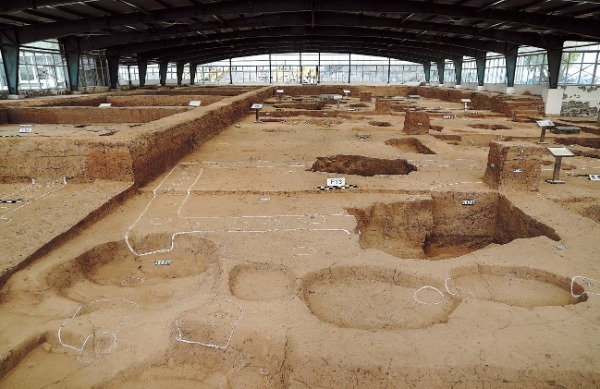
Since the discovery of the Shuanghuaishu Site, continuous excavations have been carried out since 2013. These excavations revealed a large settlement with a complex layout, including three ring trenches forming a strict defense system, large-scale residential compounds, public cemeteries and areas designated for religious sacrifices. The archaeological work has been conducted in phases, meticulously uncovering various elements of the site's infrastructure and relics that demonstrate its significance as a high-standard capital city during the Yangshao Culture period.
Key Findings
Among the key findings at the Shuanghuaishu Site are the remains of three massive moats encircling the central residential area, rigidly planned public graveyards, terraces for religious sacrifices, and a large-scale residential complex. Additionally, the discovery of astronomical relics, such as a set of pottery pots arranged in the pattern of the Big Dipper, provides insights into the advanced astronomical knowledge possessed by the site's inhabitants. Artifacts, including a silkworm statuette made of boar teeth, are believed to be among China's earliest depictions of silkworms, highlighting the early development of silk production.
Cultural Significance
Artifacts
The artifacts unearthed at the Shuanghuaishu Site offer a wealth of information regarding the social, cultural and technological practices of its ancient inhabitants. Among these artifacts are clay pots arranged to mimic the Big Dipper, symbolizing political rituals, and a boar tusk carving of a silkworm, indicative of early silk culture. The presence of these items suggests a complex societal structure with established rituals and a strong emphasis on symbolic representation and possibly religious beliefs.
Architectural Remains
The architectural remains at the Shuanghuaishu Site are remarkable for their sophistication and scale. The site includes large residential compounds, a high rammed earth platform suggesting the presence of a palace, and a grand square potentially used for administrative purposes. These features reflect an advanced level of urban planning and societal organization, indicative of a high-standing settlement presumed to be of great political and cultural importance during its time.
Burial Practices
The burial practices uncovered at the Shuanghuaishu Site reveal a well-organized and hierarchical society. The presence of public cemeteries and graveyards reflects a structured approach to burial and likely indicates social stratification. Additionally, the discovery of urn coffins resembling silkworm pupae suggests symbolic meanings attached to burial rites, potentially indicating beliefs in rebirth or an afterlife connected to religious or spiritual ideologies.
Preservation Efforts
Efforts to preserve the Shuanghuaishu Site are ongoing, with archaeologists and cultural heritage professionals working to protect and manage the site. Advanced technologies are employed in the analysis of archaeological finds, ensuring the longevity of artifacts and structural remains. These preservation efforts are crucial for maintaining the site's integrity and allowing for continued research and public education on this historically significant site.








